Fast Track
Published in Wingspan Vol. 13 Issue 1
Reporter's Insight:
At the Medill Northwestern Institute last summer, we wrote trend stories. While I’ve had experience writing trend stories because Wingspan sets itself up well for them, I all of a sudden had a burst of trend story ideas. The main one that came to mind, since all of our sports reporters had graduated the previous year, was to turn a few sports stories into trend stories.
Fast Track was my solid attempt at showing my team that sports stories can be unique. The story was initially supposed to be about the rise of student athletes signing to college early. But as I talked to more and more athletes I found out that really it just depended on the sport. So, I shifted the story to focus on how different paths work and why there isn’t one single path to collegiate athletics.
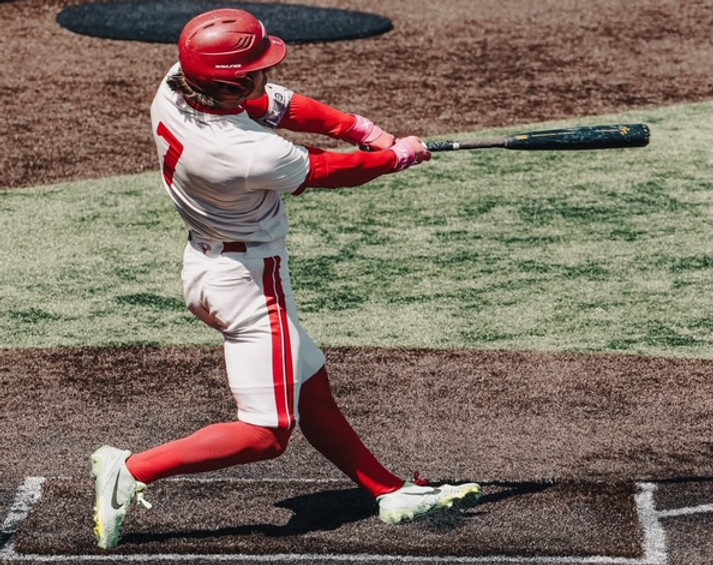
PHOTO PROVIDED BY: TINA VINCENT
Wyatt Vincent, a 2025 Nixa High School graduate and current New York Mets player, takes a swing during a baseball game.
Fast Track
The athletic recruitment experience differs for Nixa athletes
STORY BY: GLENNIS WOOSLEY
Wyatt Vincent, a 2025 Nixa High School graduate and current New York Mets player, received his first collegiate baseball offer in eighth grade from the University of Missouri. By his sophomore year, he had fielded roughly a dozen more and signed to Missouri State University.
“I had all the offers I wanted at that point,” Vincent said. “It was better to get it out of the way because then I could just focus on playing the game.”
For high school athletes, the recruiting process tends to follow a predictable path: years of practice in club and school teams, showcase events and attention from college programs later in high school. However, some athletes move outside this timeline, earning college offers early and, in turn, highlighting that while the system provides a standard road map, individual experiences vary.
Vincent gained traction during his sophomore summer season through club baseball, which led to offers from Georgia Institute of Technology, West Virginia University and Missouri State University.
“I played on two summer ball teams sophomore year,” Vincent said. “I played 130 to 140 games in four to five months.”
During his final summer ball season on the Sticks Baseball 17U Brewster/White Sox Scout Team, Vincent noticed fewer college coaches at the games, replaced by professional scouts.
“We had 31 players and 29 Division I hits,” Vincent said. “So, not many college coaches were looking at me at that point, and that’s kind of when scouts started showing up. … I think 90 percent of our games, we had two to four scouts.”
With professional scouts attending more games, Vincent was invited to participate in workouts with several professional teams, including the New York Mets, who drafted him in the 11th round. While he was originally signed to Missouri State, Vincent said he wanted to pursue professional baseball.
“I already made up my mind that I was going to sign just because I really wanted to start pro baseball as soon as I could,” Vincent said.
While Vincent’s path moved quickly, not every athlete follows the same timeline. For senior Gwen Kubik, the recruiting process took a more traditional route.
Kubik committed to Drury University for volleyball last January. Initially, she wasn’t certain she wanted to play at the collegiate level.
“I went back and forth between wanting to play and not wanting to play,” Kubik said. “But ultimately, I decided that it’s probably good for me.”
During her junior year, Kubik attended a campus visit at Drury, touring the facilities and meeting with coaches. However, her decision was based on academic motivations.
“I want to go to medical school after college,” Kubik said. “It was really important to find a program with strong academics.”
For younger athletes, Kubik said it is important to start talking to coaches early.
“I waited a little too long, but it’s important to get the conversation going if you want to play at the next level,” Kubik said.
Head volleyball coach Annie Zimmerman said there’s no single timeline for recruiting.
“Some athletes get attention early, others later,” Zimmerman said. “It really depends on the sport, the level of play and even the athlete’s focus on club versus school teams.”
Zimmerman said she’s seen more college coaches recruiting multi-sport athletes. This matches both Vincent’s and Kubik’s experiences as they were multi-sport athletes. Vincent played baseball, football and basketball in high school, while Kubik competed in volleyball, basketball and track.
“The multi-sport athletes tend to do the best as far as injury prevention, just because their bodies are capable of doing multiple things,” Zimmerman said.